

Meta is making one of its boldest AI infrastructure moves yet.
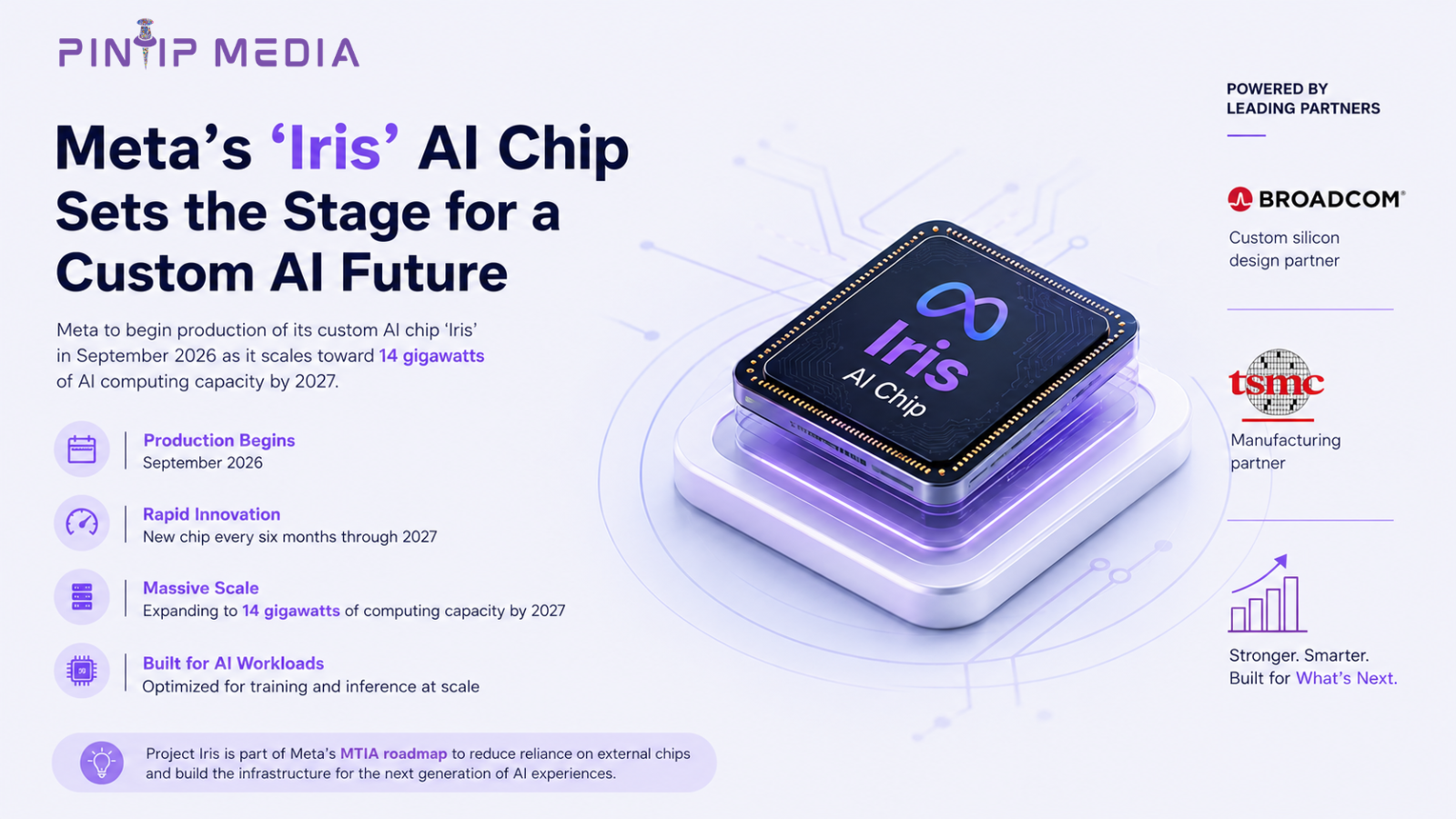
According to reports, the company plans to begin production of its custom “Iris” AI chip in September 2026, signaling a major shift away from relying entirely on third-party chipmakers like Nvidia and AMD. But this isn’t simply about designing another AI accelerator it’s about owning the entire AI stack.
With plans to scale its computing infrastructure to 14 gigawatts by 2027, Meta is betting that custom silicon will become the backbone of its future AI ambitions.
Why Is Meta Building the Iris AI Chip?
For years, companies developing large AI models have depended heavily on GPUs from Nvidia and AMD. While those chips offer incredible performance, they’re also expensive, difficult to secure, and designed for a wide range of workloads rather than one company’s specific needs.
Meta’s answer is Project Iris.
The new chip is part of the company’s Meta Training and Inference Accelerators (MTIA) roadmap, a multi-generation family of AI processors built specifically for Meta’s internal AI systems powering Facebook, Instagram, Threads, and WhatsApp.
Instead of replacing GPUs overnight, Iris is expected to handle workloads where custom hardware can deliver better efficiency, lower costs, and improved performance.
A Faster Chip Development Strategy
One of the most interesting aspects of Meta’s announcement is its development timeline.
Rather than releasing new hardware every one or two years like many semiconductor companies, Meta plans to introduce a new AI chip approximately every six months through 2027. This rapid iteration strategy allows the company to adapt quickly as AI models evolve.
According to an internal memo reviewed by Reuters, Iris completed its testing phase in only six weeks without major issues an encouraging sign for a project that has taken years to mature.
Broadcom and TSMC Play Critical Roles
Meta isn’t building Iris entirely on its own.
The company is collaborating with Broadcom, which is helping design the custom silicon, while TSMC (Taiwan Semiconductor Manufacturing Company) will manufacture the chips using its advanced fabrication technology.
This partnership combines Meta’s AI expertise with two of the semiconductor industry’s most experienced companies, allowing Meta to accelerate deployment without building its own fabrication facilities.
The 14-Gigawatt AI Infrastructure Goal
Perhaps the biggest headline isn’t the chip itself it’s the scale behind it.
Meta plans to expand its AI computing capacity from roughly 7 gigawatts in 2026 to 14 gigawatts in 2027, effectively doubling the infrastructure available for AI training and inference. The company is also expected to invest as much as $145 billion in AI infrastructure during 2026, underscoring how central AI has become to its long-term strategy.
That level of compute will support increasingly sophisticated AI experiences across Meta’s products while reducing operational costs over time.
What This Means for the AI Industry
Meta’s Iris project reflects a broader trend across the technology industry.
Rather than relying solely on general-purpose GPUs, major AI companies are increasingly designing custom AI chips optimized for their own workloads. The goal isn’t necessarily to eliminate Nvidia or AMD, but to improve efficiency, control costs, and reduce supply chain risks.
As AI adoption accelerates, infrastructure not just models will become a key competitive advantage.
Final Thoughts
Meta’s Iris AI chip is more than another hardware announcement it’s a glimpse into the future of enterprise AI infrastructure.
By investing in custom silicon, accelerating chip development cycles, and scaling toward 14 gigawatts of compute, Meta is positioning itself to control more of its AI ecosystem. Whether this strategy reshapes the competitive landscape remains to be seen, but one thing is already clear: the next phase of the AI race won’t be won by software alone it will also be powered by the chips running underneath it.