
If you’ve been following the AI industry lately, you’ve probably seen headlines suggesting that open-source AI is taking over.
At first glance, it makes sense.
Open-source models are becoming more capable, more affordable, and easier for businesses to customize. So it’s easy to assume that premium AI platforms are on their way out.
But that’s not what’s happening.
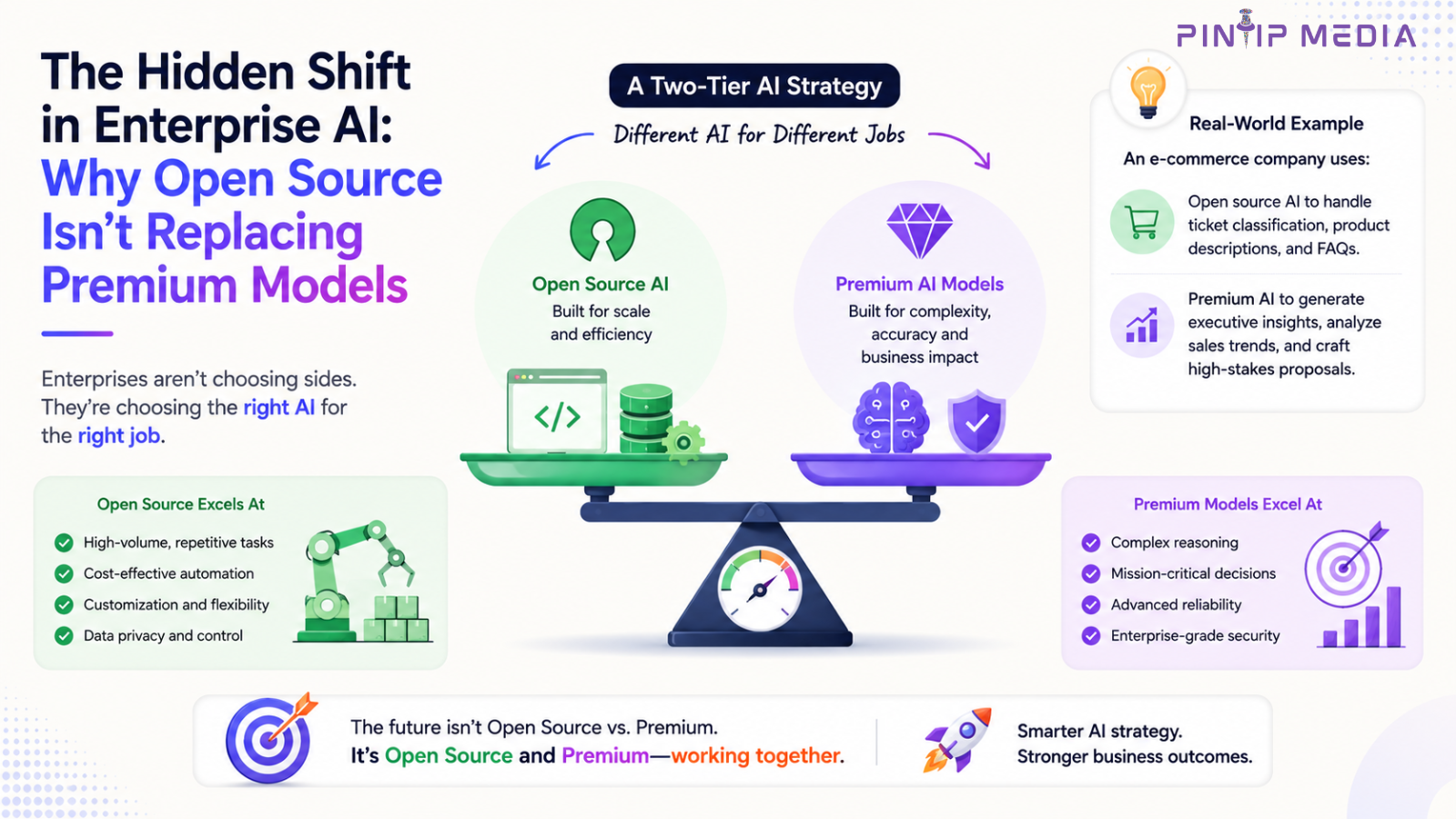
Instead of replacing premium AI models, open-source AI is creating a two-tier enterprise AI strategy one where businesses use different models for different jobs.
That’s the real shift happening in 2026.
The Enterprise AI Conversation Has Changed
A year ago, the biggest question was:
“Which AI model should we use?”
Today, it’s become:
“Which AI model should we use for this specific task?”
That’s a major difference.
Enterprise leaders are realizing that AI isn’t a one size fits all technology. Just as companies use different software for accounting, CRM, and project management, they’re now building AI stacks with multiple models serving different purposes.
Open Source Excels at Scale
Open-source AI has become incredibly attractive for repetitive, high-volume workloads.
Think about tasks like:
- Summarizing thousands of support tickets
- Categorizing customer feedback
- Internal document searches
- Drafting routine emails
- Automating knowledge base updates
These jobs happen every day and often require processing millions of tokens.
Running them on open-source models can significantly reduce infrastructure costs while giving companies more control over deployment and customization.
For many organizations, that’s a smart business decision.
Premium Models Still Solve the Hardest Problems
Now imagine a different scenario.
A global pharmaceutical company is preparing regulatory documents for multiple countries.
Every response must be accurate, nuanced, and consistent because mistakes could delay approvals or create compliance risks.
Or consider a law firm analyzing complex contracts involving multiple jurisdictions.
These aren’t tasks where businesses simply choose the lowest-cost model.
They’re looking for advanced reasoning, reliability, sophisticated context handling, enterprise-grade security, and ongoing model improvements.
This is where premium AI models continue to deliver value.
The cost of making the wrong decision is often far greater than the cost of using a premium model.
A Simple Example
Imagine an e-commerce company processing 500,000 customer interactions every week.
It might use:
- An open-source model to classify support tickets, generate product descriptions, and answer routine customer questions.
- A premium AI model to assist executives with strategic planning, analyze complex sales trends, or create high stakes customer proposals.
Both models contribute to the business.
They simply solve different problems.
The Future Isn’t “Open Source vs. Premium”
It’s “Open Source and Premium.”
This hybrid approach allows businesses to balance performance, cost, flexibility, and security.
Routine tasks go to cost-efficient models.
Mission-critical decisions rely on premium intelligence.
The result is a smarter AI strategy not an either-or decision.
The Bottom Line
The biggest misconception in today’s AI market is that one type of model will eventually replace the other.
Enterprise adoption tells a different story.
Companies aren’t choosing sides.
They’re choosing the right tool for the right workload.
As AI becomes embedded across every department, success won’t come from using the most expensive model or the cheapest one.
It will come from knowing where premium intelligence creates business value and where open-source efficiency delivers scale.
That’s the hidden shift shaping enterprise AI in 2026, and it’s likely to define how organizations build their AI strategies for years to come.