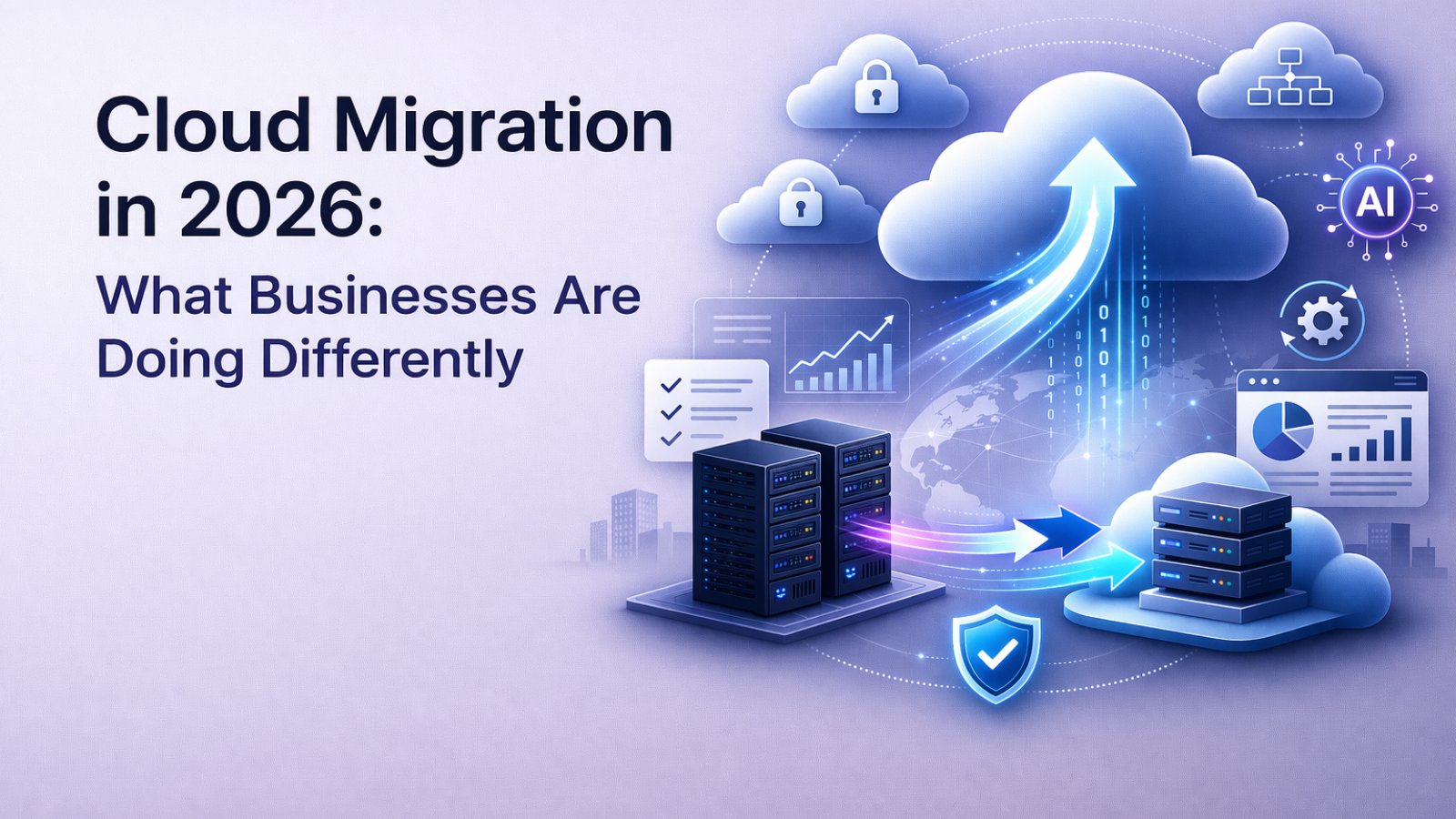

Cloud migration in 2026 is no longer just about moving servers or applications from on-premise systems to the cloud. Businesses are taking a more selective, business-first approach that emphasizes resilience, cost control, AI readiness, and security from day one. Analysts point to the same shift: cloud has moved from a technical destination to a business platform.
Why cloud migration looks different in 2026
A few years ago, many organizations treated migration as a “lift-and-shift” project. In 2026, that approach is losing ground. Gartner says the trends shaping cloud adoption include cloud dissatisfaction, AI and machine learning, multicloud, and digital sovereignty. That means businesses are no longer asking how quickly they can move everything. They are asking which workloads should move, where they should run, and what business value they will create.
Microsoft’s Cloud Adoption Framework also reflects this more strategic mindset. Its current guidance emphasizes that cloud adoption should align with business goals rather than ad hoc technical decisions.
Hybrid and multicloud are becoming the default
One of the biggest changes in cloud migration in 2026 is the rise of hybrid and multicloud strategies. Instead of committing every workload to a single environment, businesses are mixing on-premises systems, edge infrastructure, and multiple cloud providers.
Microsoft’s current hybrid and multicloud guidance says enterprises use these models to improve resilience, compliance, and cost efficiency, while creating a unified operating model across environments. That is a major shift from the old idea that cloud migration always meant moving everything into one public cloud.
AI workloads are changing migration priorities
AI is now influencing where and how businesses migrate. Cloud strategies are increasingly shaped by the need to support data-heavy AI applications, automation, model operations, and intelligent services.
Forrester’s 2026 cloud outlook says cloud computing this year is being shaped by private AI on private clouds, AI-native innovation, and the rise of neoclouds. Its 2026 technology and security predictions also say enterprise adoption of neoclouds will surge as organizations look for GPU-heavy infrastructure, orchestration, and sovereign AI options.
Cost control matters more than before
Cloud migration in 2026 is also more financially disciplined. Businesses are paying closer attention to cloud sprawl, workload efficiency, and long-term operating costs. This is one reason hybrid and multicloud models are gaining traction: they give teams more flexibility to place workloads where they make the most financial sense.
Microsoft’s planning guidance for hybrid and multicloud explicitly ties cloud strategy to agility, resilience, cost optimization, and innovation. That signals a move toward more deliberate migration planning instead of broad, one-time relocation efforts.
Security is built into migration earlier
Another major shift is that security is no longer treated as a post-migration fix. In 2026, businesses are designing identity, governance, monitoring, and protection controls much earlier in the migration journey.
Microsoft’s operational guidance for cloud adoption stresses planning governance, security, and operations teams as part of preparing the organization for cloud. Forrester’s 2026 infrastructure and operations predictions also point to growing emphasis on secure, integrated environments as AI adoption expands.
Sovereignty and location strategy are rising concerns
Businesses in regulated industries, or those operating across regions, are paying more attention to where their cloud environments are hosted and how that affects compliance and risk. Gartner identifies digital sovereignty as one of the top trends shaping the future of cloud. Forrester’s 2026 predictions also point to growth in sovereign and regional AI-oriented cloud options.
What businesses are doing differently in 2026
The companies getting cloud migration right in 2026 are doing a few things differently:
- They are migrating selectively, not moving everything at once.
- They are designing around hybrid and multicloud realities.
- They are aligning migration with AI readiness.
- They are treating cost optimization as part of strategy, not cleanup.
- They are embedding security and governance early.
- They are considering sovereignty and workload placement much more carefully.
Final thoughts
Cloud migration in 2026 is less about relocation and more about transformation. Businesses are moving away from simple lift-and-shift projects and toward cloud strategies built for resilience, AI, cost discipline, and security. The strongest results are coming from organizations that treat cloud as a long-term business capability, not just an infrastructure upgrade.