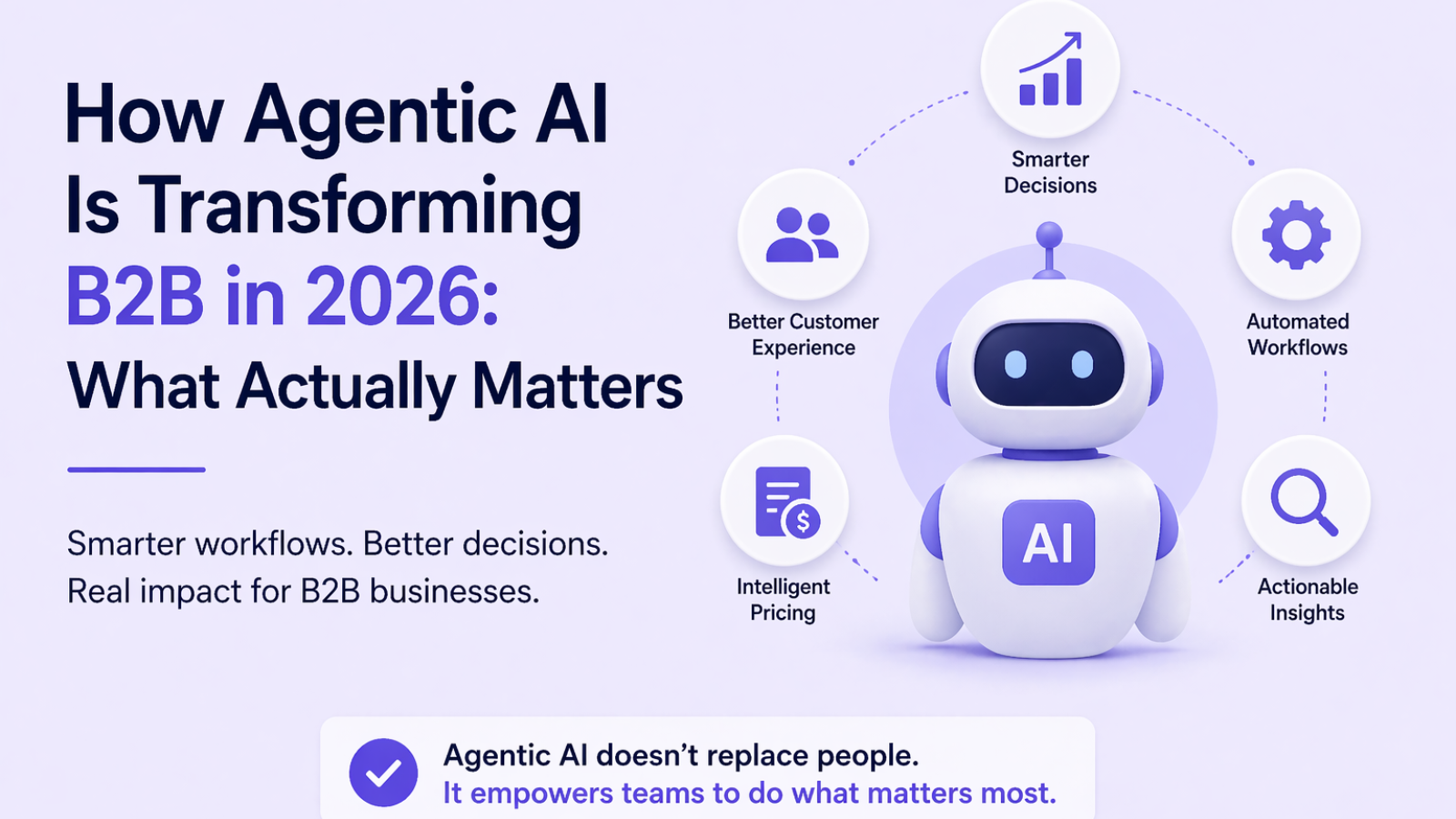

In 2024, a lot of the conversation around AI in B2B felt oversized. Every week, there was a new promise: fully autonomous sales, self-running support, AI that would replace teams instead of helping them.
In 2026, the picture is clearer — and honestly, more useful.
Agentic AI is starting to matter in B2B not because it can do everything, but because it can do specific work inside real business workflows. That is the shift that actually matters. McKinsey says agentic AI promises a “fundamental shift” in how B2B pricing is set and managed, while Gartner predicts that 40% of enterprise applications will include task-specific AI agents by the end of 2026, up from less than 5% in 2025.
So, what is agentic AI in B2B?
Put simply, agentic AI is AI that does more than answer questions. It can take action, complete tasks, and move work forward within defined rules. That does not mean businesses are handing over the keys. The real value is showing up in bounded, high-value use cases: pricing support, quote workflows, customer service actions, internal research, account analysis, and process coordination. Microsoft’s current enterprise guidance frames this as shifting responsibility to AI systems within clear boundaries, not removing human control.
Where B2B teams are seeing real impact
The biggest change is happening in workflows where speed, context, and consistency matter. In pricing, agentic AI is helping companies analyze data, recommend actions, and improve responsiveness in ways that were previously too slow or manual. McKinsey says this is where agentic AI could create a step change in both efficiency and effectiveness.
In customer-facing environments, the same pattern is emerging. B2B companies are using agents to support service operations, guide decisions, and handle repeatable actions — but still with governance and oversight. McKinsey’s 2026 B2B survey also points to agentic AI creating value alongside a growing need for stronger execution, integration, and trust.
That last point matters more than the hype.
Because the companies getting value from agentic AI are not the ones chasing autonomy for its own sake. They are the ones asking better questions:
- Where does work get stuck?
- Which tasks are repetitive but important?
- Where can AI act safely with the right context?
- Where does a human still need to step in?
What actually matters in 2026
Three things stand out.
First, context matters more than capability.
An AI agent is only useful if it has the right business context, data access, and workflow boundaries. Without that, it becomes impressive but unreliable.
Second, trust is now part of the product.
B2B buyers and operators are not looking for “smart” systems alone. They want systems that are auditable, explainable, and safe to use in real decisions. McKinsey’s latest B2B research points to trust rising in importance as agentic AI becomes part of execution.
Third, augmentation is beating replacement.
The best implementations are not removing humans from the loop entirely. They are helping teams move faster, prioritize better, and spend more time on judgment-heavy work. Gartner’s forecast about task-specific agents supports that idea: adoption is growing through embedded, focused use cases, not one giant autonomous system doing everything.
What this means for B2B leaders
If you are thinking about agentic AI in 2026, the smartest move is not to ask, “How do we automate the whole function?”
Ask, “Which part of the workflow would improve if AI could take the next best action reliably?”
That is where the real transformation is happening.
Not in dramatic replacement stories.
Not in vague AI branding.
Not in endless pilot projects with no operational value.
The real shift is quieter than that.
Agentic AI is transforming B2B by making specific workflows more responsive, more scalable, and more useful — as long as companies pair it with good data, strong guardrails, and human judgment. Google’s current search guidance would call this the same principle good content needs: be useful, reliable, and built for real people. In many ways, that is also the best test for AI in business.
Our Prespective
In 2026, what matters is not whether agentic AI sounds impressive. What matters is whether it helps a B2B team do meaningful work better. That is the difference between AI hype and AI value.In 2024, a lot of the conversation around AI in B2B felt oversized. Every week, there was a new promise: fully autonomous sales, self-running support, AI that would replace teams instead of helping them.
In 2026, the picture is clearer — and honestly, more useful.
Agentic AI is starting to matter in B2B not because it can do everything, but because it can do specific work inside real business workflows. That is the shift that actually matters. McKinsey says agentic AI promises a “fundamental shift” in how B2B pricing is set and managed, while Gartner predicts that 40% of enterprise applications will include task-specific AI agents by the end of 2026, up from less than 5% in 2025.