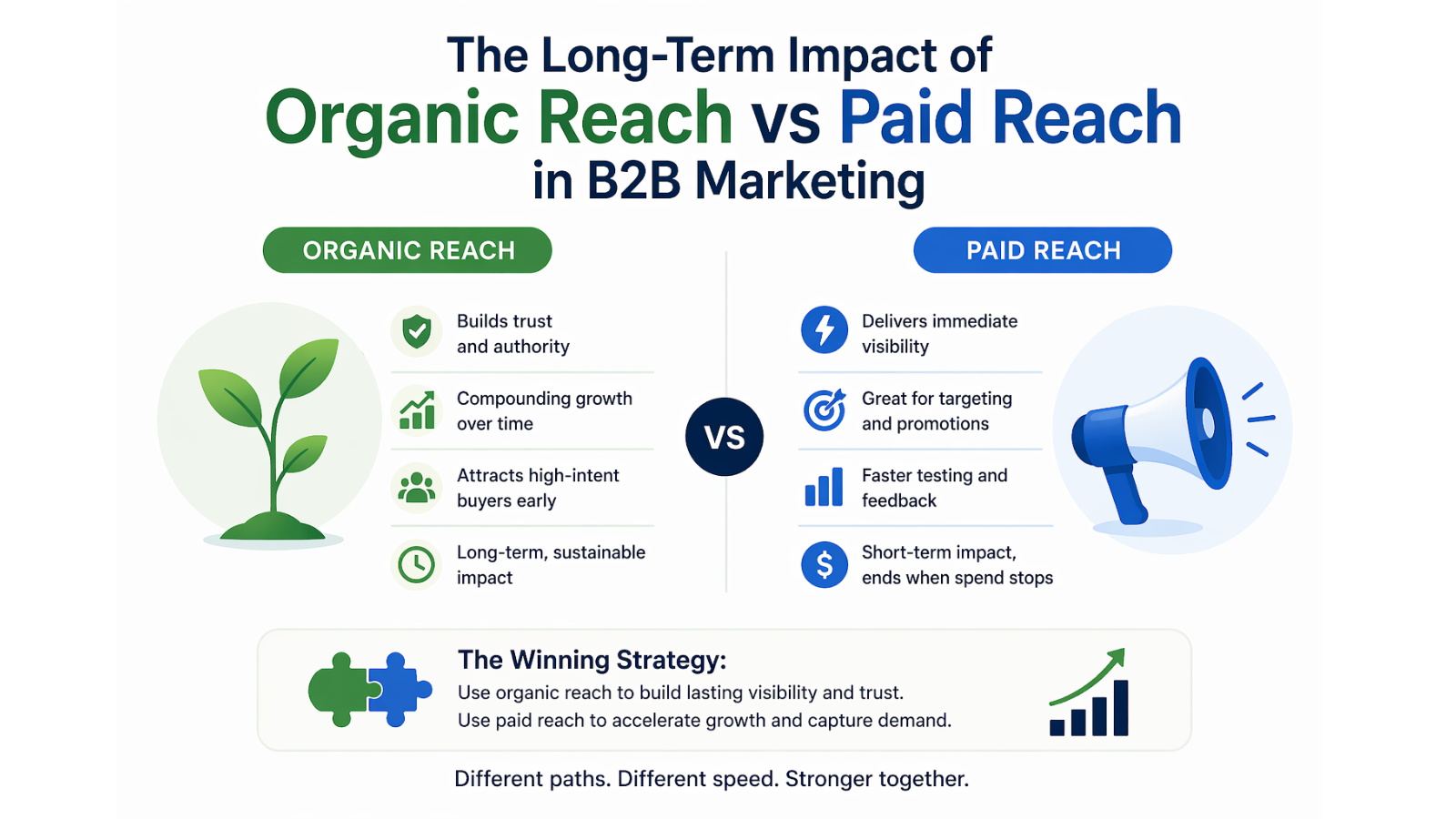

In B2B marketing, the debate is not really organic vs paid. The better question is: what does each channel do over time, and how should they work together? That matters more in 2026 because B2B buyers are increasingly self-directed. Gartner reported in March 2026 that 67% of B2B buyers prefer a rep-free experience, and 45% said they used AI during a recent purchase, which means buyers are discovering, comparing, and shortlisting vendors before direct sales conversations happen.
Organic reach builds compounding visibility
Organic reach in B2B usually comes from SEO, thought leadership, social visibility, newsletters, and content that keeps attracting the right audience over time. Its long-term advantage is not speed. It is compounding value. One strong page, article, case study, or category resource can continue earning impressions, visits, and trust long after it is published. That fits how modern search works: Google says its systems prioritize helpful, reliable, people-first content rather than content created mainly to manipulate rankings.
That makes organic especially valuable in B2B because buyers often do heavy research before they ever raise their hand. 6sense’s 2025 Buyer Experience Report found that buyers frequently form preferences early, with preliminary shortlists often built before engaging sellers. In practical terms, organic reach helps brands show up during that research phase, when buyers are still shaping vendor awareness and trust.
Paid reach creates immediate visibility and faster testing
Paid reach plays a different role. It helps B2B teams generate immediate exposure, accelerate message testing, support launches, promote high-value offers, and capture demand already in motion. In markets where buyers want autonomy and move quickly, paid can help a brand appear exactly when a prospect is searching, comparing, or ready to act. That short-term responsiveness is hard for organic alone to match.
Paid is also useful because it gives marketing teams faster feedback loops. You can test headlines, offers, audiences, landing pages, and positioning much more quickly than with organic alone. That does not make paid better in the long term. It makes it better at speed. The long-term risk is that once spending stops, visibility usually drops with it. Organic tends to compound; paid tends to rent attention. That second point is an inference from how the two channels operate, but it is exactly why many B2B teams use paid for acceleration and organic for endurance. Supported by buyer behavior research showing earlier, self-directed evaluation, the logic is that sustainable visibility matters more when buyers shortlist vendors before direct contact.
The long-term impact on trust is different
Over time, organic reach often strengthens brand trust more naturally because it is tied to discoverability, expertise, and repeated helpful interactions. When a buyer repeatedly sees useful blog posts, practical guides, ranking pages, comparison resources, or thought leadership from one brand, that brand becomes easier to trust. Google’s people-first guidance reinforces this: search visibility increasingly rewards content that demonstrates usefulness, originality, and relevance.
Paid reach can absolutely support trust, but it usually needs stronger proof to do it. A paid ad may win the click, but the landing page, case study, proof point, or offer has to carry the credibility. In B2B, that matters because buyers are more cautious and more conservative in their choices. 6sense’s 2025 report found that economic uncertainty is pushing buyers toward more conservative vendor decisions, which means trust and proof are doing more work in conversion than they did before.
The long-term impact on pipeline is also different
Organic reach tends to improve pipeline quality gradually. It attracts buyers who are actively researching, learning, and evaluating. Those visitors may not convert immediately, but they often enter the funnel with stronger context and better fit. Over time, that can improve lead quality, content-assisted pipeline, and sales conversations because buyers have already consumed valuable information before speaking to the team. That aligns with 6sense’s finding that the moment of persuasion is happening earlier in the B2B journey.
Paid reach tends to affect pipeline faster. It is better for demand capture, retargeting, event promotion, high-intent offers, and fast campaign bursts. If you need meetings this quarter, paid usually contributes faster than SEO or long-form organic content. But its long-term efficiency depends on message quality, conversion experience, and budget discipline. Without strong positioning and helpful content underneath, paid can create clicks without building real market preference. Google’s content guidance is relevant here too: even if paid gets the visit, the page still has to be genuinely useful.
Why the strongest B2B strategy uses both
The best long-term B2B strategy is usually not choosing one over the other. It is using both channels for what they do best. Organic reach builds discoverability, authority, and durable market presence. Paid reach amplifies timing, testing, and demand capture. Together, they create a system where paid can surface what resonates now, while organic builds the long-term visibility and trust that reduce dependence on paid alone. That is increasingly important as AI changes both how marketers produce content and how buyers evaluate vendors. HubSpot’s 2025 AI report shows AI is already mainstream in marketing workflows, which means more content is being created and competition for attention is rising.
In that environment, organic reach helps a brand stay visible when buyers research independently, and paid helps a brand stay present when buyers show stronger intent signals. One compounds. One accelerates. The strongest B2B teams understand that both are necessary, but they behave differently over time.
Final thought
The long-term impact of organic reach vs paid reach in B2B marketing comes down to this:
Paid reach helps you move faster.
Organic reach helps you last longer.
If your business depends only on paid, you may buy visibility without building enough trust or compounding discovery. If you depend only on organic, you may miss short-term opportunities to test, promote, and capture demand quickly. In 2026, the smarter approach is to treat organic as the long-term asset and paid as the strategic amplifier. That is how B2B brands build both immediate momentum and durable growth.