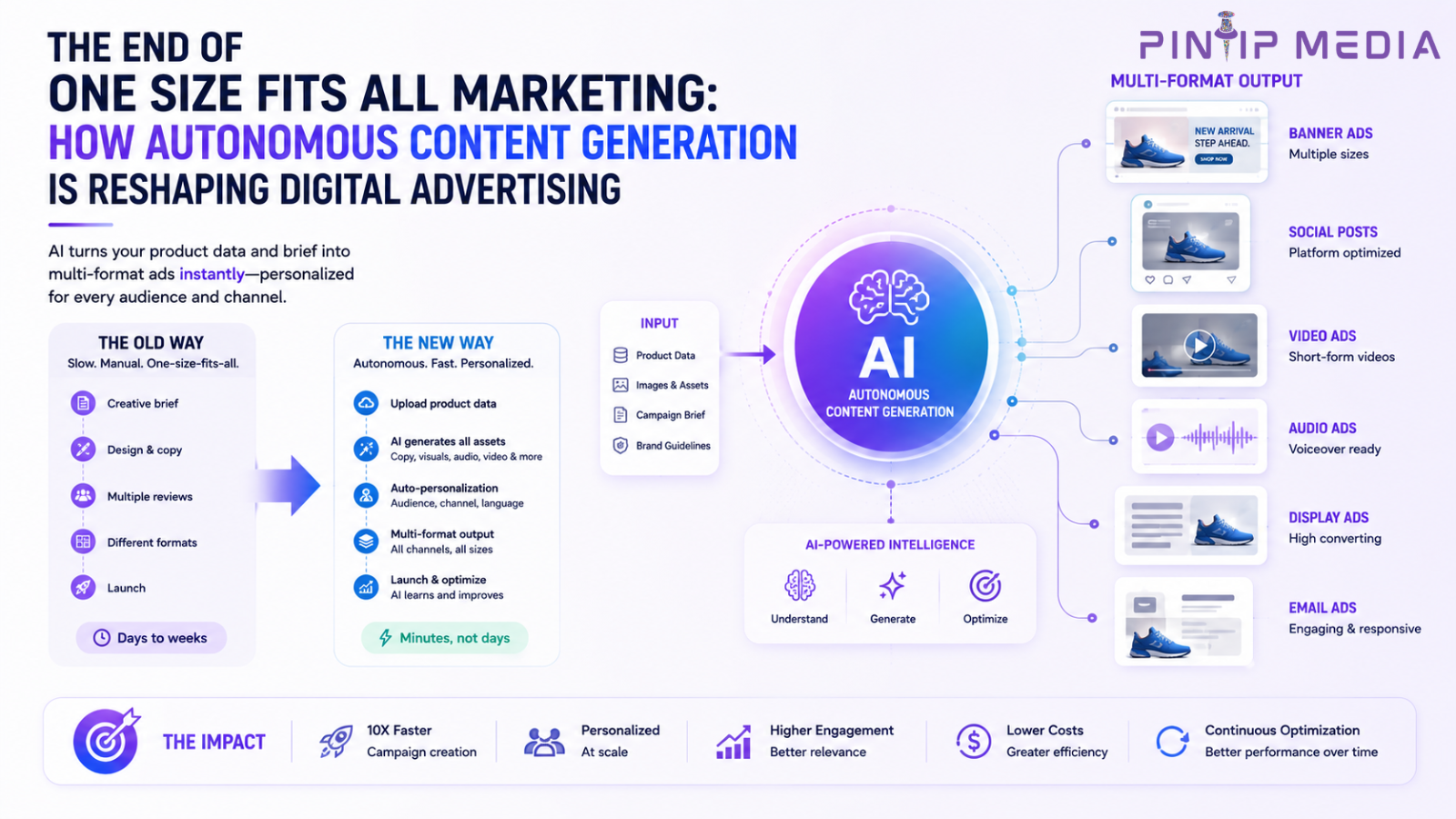

or years, digital advertising followed a familiar workflow. A marketing team wrote a creative brief, designers created visuals, copywriters drafted headlines, video editors produced campaign assets, and everything went through multiple rounds of approval before launch.
It worked but it wasn’t built for today’s pace.
In 2026, customer preferences change by the hour, trends emerge overnight, and campaigns need to adapt across dozens of channels. That’s why marketers are embracing a new approach: Autonomous Content Generation.
Instead of simply helping marketers write copy, AI is now capable of turning raw product information into complete, multi-format marketing campaigns in minutes.
The question is no longer “Can AI create content?” It’s “How quickly can AI create the right content for the right audience?”
Marketing Is Moving Beyond Manual Creative Work
Imagine launching a new product.
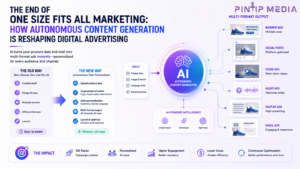
Rather than asking your creative team to build separate assets for your website, LinkedIn, Instagram, YouTube, display ads, and email campaigns, you upload your product details, pricing, images, and a short campaign brief.
AI then generates:
- Banner ads in multiple sizes
- Social media posts
- Short-form videos
- Product explainer videos
- Audio ads
- Display creatives
- Email visuals
- Platform-specific copy
all while maintaining consistent branding and messaging.
Instead of creating one campaign, marketers can instantly create dozens of personalized variations designed for different audiences and channels.
Personalization Is Finally Becoming Scalable
Modern buyers expect content that feels relevant.
A manufacturing executive doesn’t want to see the same message as a healthcare decision-maker. A first-time visitor shouldn’t receive the same creative as an existing customer.
Autonomous Content Generation makes this level of personalization possible without multiplying production time.
AI can automatically adjust headlines, visuals, calls to action, formats, and messaging based on audience segments, campaign goals, geographic markets, or even the platform where the ad appears.
It’s personalization at a scale that would be nearly impossible through manual workflows alone.
AI Is Becoming a Creative Partner
One of the biggest misconceptions is that autonomous AI replaces creative teams.
In reality, it’s changing what those teams spend their time doing.
Instead of creating every version from scratch, marketers are defining the strategy, brand voice, campaign objectives, and customer insights. AI handles the repetitive production work, freeing creative professionals to focus on storytelling, experimentation, and innovation.
The result is faster execution without sacrificing quality.
Smarter Campaigns Through Continuous Optimization
Autonomous content doesn’t stop once a campaign goes live.
Modern AI platforms can monitor engagement, click-through rates, conversions, and audience behavior in real time. Based on performance, they can recommend—or even generate new creative variations that better match what customers respond to.
This creates a continuous optimization loop where campaigns evolve instead of remaining static.
Why This Matters for B2B Marketing
While autonomous content generation has gained attention in consumer advertising, its impact on B2B marketing is just as significant.
Enterprise marketers often need to create assets for multiple industries, buying personas, account-based marketing (ABM) campaigns, webinars, events, landing pages, and sales enablement materials.
AI helps accelerate this process while maintaining consistency across every touchpoint.
For lean marketing teams, it also means achieving more with fewer manual tasks and shorter production cycles.
The Bottom Line
The future of digital advertising isn’t about producing more content—it’s about producing smarter, more relevant content at the speed buyers expect.
Autonomous Content Generation is helping businesses move from slow, one-size-fits-all campaigns to dynamic, personalized experiences that adapt across channels and audiences in real time.
The brands that succeed won’t be the ones creating the most ads—they’ll be the ones creating the right ad for the right person at the right moment.
That’s where autonomous content is taking digital marketing next.
Key Takeaways
- AI is evolving from content creation to end-to-end campaign generation.
- Autonomous Content Generation transforms product data into banners, videos, audio ads, and social creatives within minutes.
- Personalized marketing at scale is becoming practical for both B2C and B2B organizations.
- Creative teams are shifting from manual production to strategy, storytelling, and brand direction.
- Continuous AI-driven optimization helps campaigns improve after launch, delivering stronger engagement and better ROI.