

For years, the race in quantum computing was all about one thing: building more qubits.
Technology companies proudly announced new milestones as they increased the number of physical qubits in their quantum processors. While those achievements were important, the industry is now shifting its focus toward something even more valuable—logical qubits.
And that shift could be what finally moves quantum computing from experimental research to real-world business applications.
The Problem with Physical Qubits
Quantum computers rely on qubits to process information. Unlike traditional computer bits, qubits can exist in multiple states at the same time, allowing them to solve certain complex problems much faster than classical computers.
The challenge is that physical qubits are highly sensitive to their environment. Even minor disturbances can introduce errors, making calculations unreliable.
As a result, simply adding more physical qubits doesn’t automatically create a more powerful quantum computer.
Why Logical Qubits Matter
Logical qubits are designed to solve this problem.
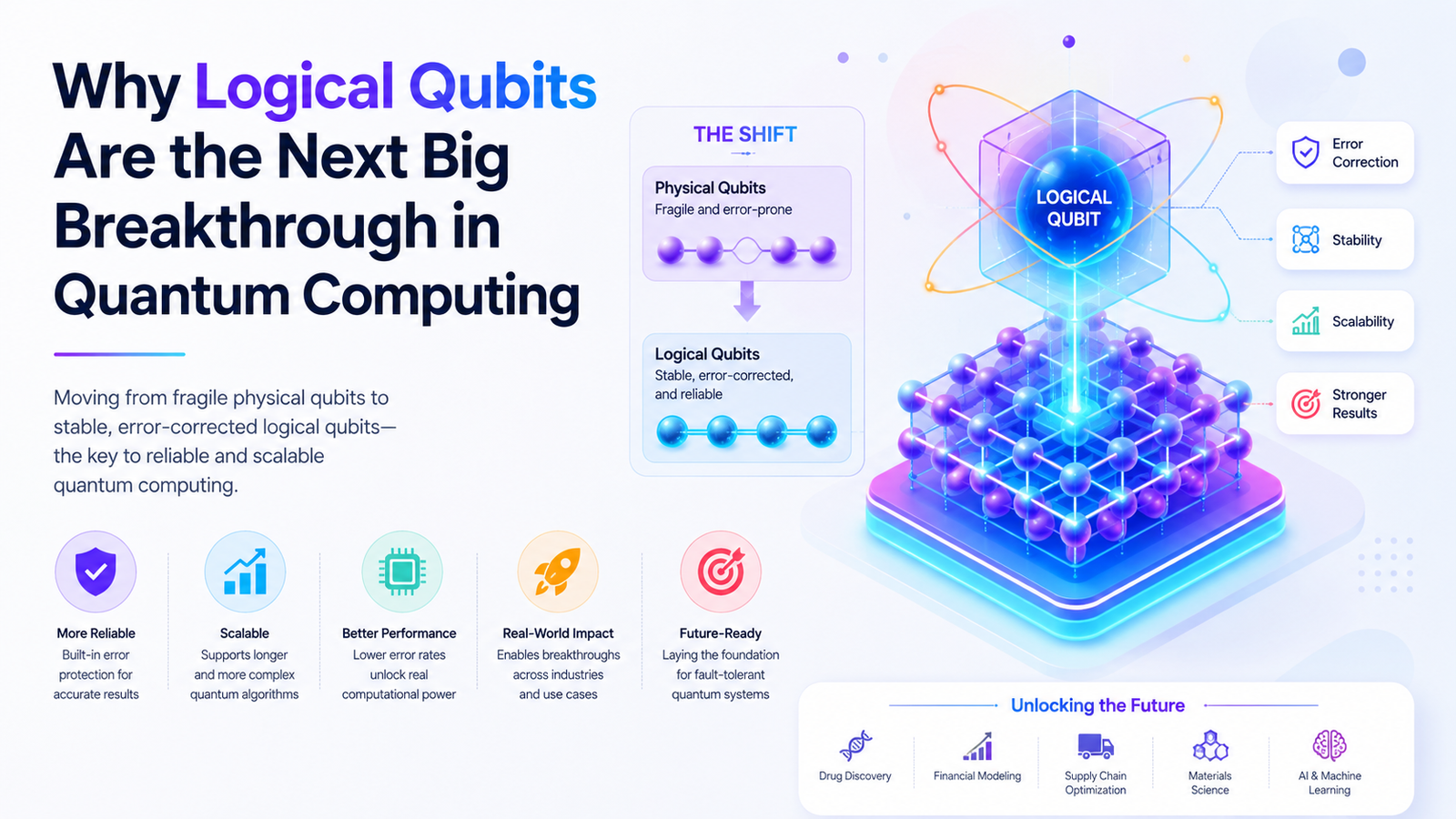
Instead of relying on a single physical qubit, researchers combine multiple physical qubits into an error-corrected system that behaves as one stable logical qubit. This approach dramatically reduces error rates and improves computational reliability.
Think of it as moving from a fragile prototype to a dependable production-ready system.
The goal isn’t just to build bigger quantum computers—it’s to build quantum computers that consistently produce accurate results.
The Breakthrough Driving the Industry
Leading technology companies are now focusing heavily on quantum error correction. By organizing physical qubits into sophisticated grids and crossing key error-correction thresholds, they are achieving significant improvements in logical qubit performance.
This progress is critical because reliable logical qubits can support longer and more complex quantum algorithms without errors disrupting calculations.
In other words, logical qubits bring the industry one step closer to practical quantum computing.
What This Means for Businesses
As logical qubit technology advances, organizations could eventually unlock new possibilities across industries, including:
- Drug discovery and molecular simulation
- Financial risk modeling
- Supply chain optimization
- Materials science research
- Advanced artificial intelligence applications
While large-scale commercial adoption is still developing, improvements in logical qubits are laying the foundation for future enterprise use cases.
Looking Ahead
The next phase of quantum computing won’t be defined by who has the most qubits. It will be defined by who can make those qubits reliable.
Logical qubits represent one of the most important breakthroughs in the industry’s evolution, bringing us closer to fault-tolerant quantum computers capable of solving problems beyond the reach of today’s most powerful systems.
For businesses tracking emerging technologies, this is a trend worth watching. The shift from physical to logical qubits may ultimately be the breakthrough that transforms quantum computing from promise into reality.