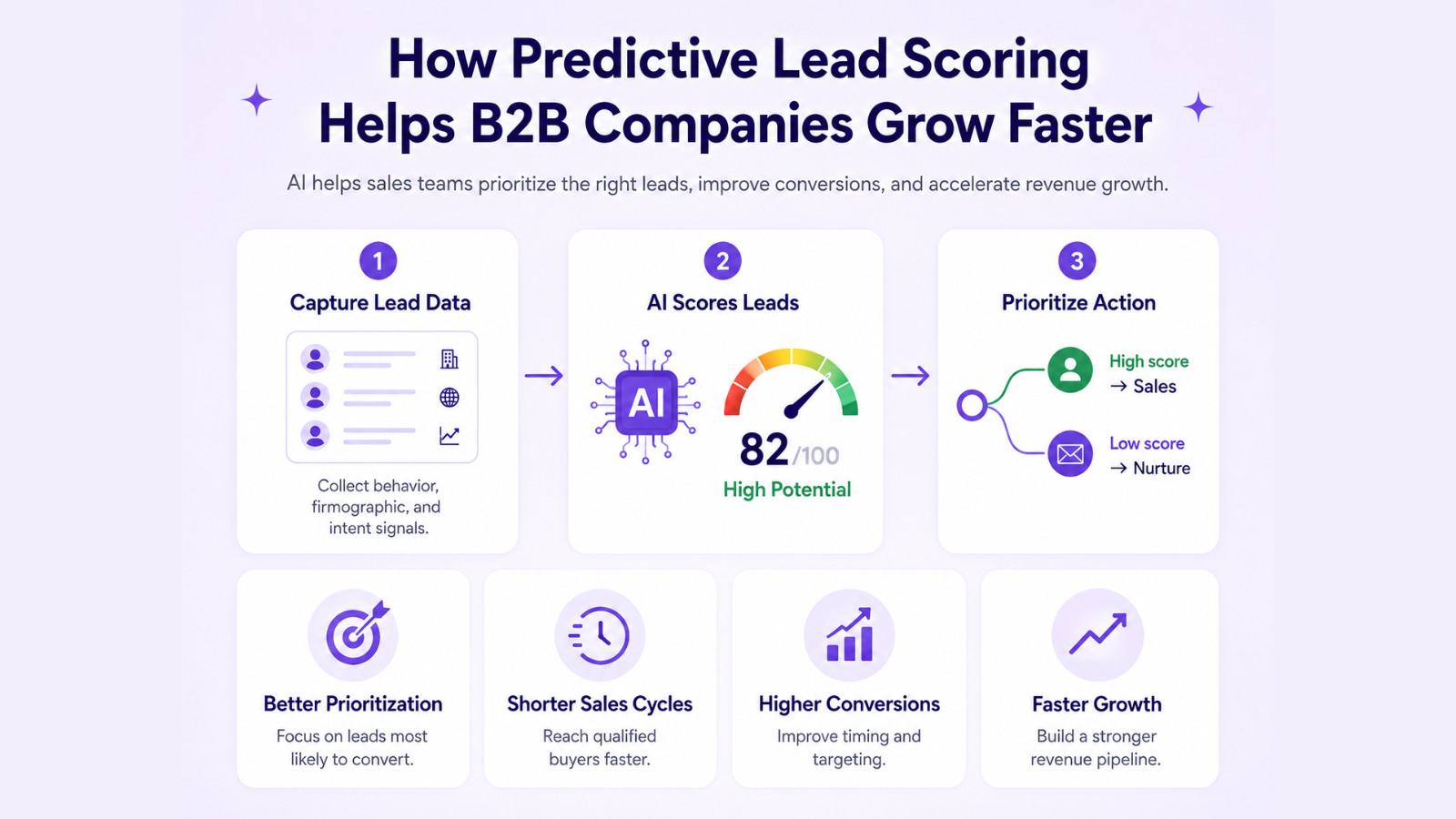

In B2B sales, not every lead is ready to buy. Some prospects are actively looking for a solution, some are still researching, and others may never convert. The challenge for sales and marketing teams is knowing which leads deserve immediate attention and which ones need more nurturing.
This is where predictive lead scoring becomes powerful.
Predictive lead scoring uses data, artificial intelligence, and machine learning to identify the leads most likely to become customers. Instead of relying only on manual judgment or basic scoring rules, B2B companies can use predictive models to prioritize better opportunities, improve sales productivity, and grow faster.
What Is Predictive Lead Scoring?
Predictive lead scoring is a data-driven method of ranking leads based on how likely they are to convert into paying customers.
Traditional lead scoring usually assigns points based on actions such as:
- Downloading a whitepaper
- Visiting a pricing page
- Opening marketing emails
- Filling out a contact form
- Matching a target industry or company size
Predictive lead scoring goes further. It analyzes historical customer data, behavior patterns, firmographic details, engagement signals, and buying intent to predict which leads have the highest chance of converting.
In simple terms, it helps answer one important question:
Which leads should the sales team focus on first?
Why B2B Companies Need Predictive Lead Scoring
B2B sales cycles are often long and complex. Multiple decision-makers may be involved, budgets may take time to approve, and prospects often compare several vendors before making a purchase.
Without a smart lead scoring system, sales teams may waste time chasing leads that are not ready or not a good fit. At the same time, high-quality leads may get ignored or contacted too late.
Predictive lead scoring helps solve this problem by giving sales and marketing teams a clear, data-backed view of lead quality.
1. It Helps Sales Teams Focus on High-Value Leads
One of the biggest advantages of predictive lead scoring is better prioritization.
Instead of treating every lead equally, sales teams can focus on prospects that show strong buying signals. These signals may include website visits, product page views, content downloads, email engagement, job titles, company size, industry, and previous interactions.
For example, a lead from a mid-sized technology company that visited the pricing page, attended a webinar, and downloaded a product comparison guide may receive a higher score than someone who only subscribed to a newsletter.
This helps sales teams spend more time on leads that are more likely to convert.
2. It Shortens the Sales Cycle
Speed matters in B2B sales. When a lead shows strong buying intent, quick follow-up can make a major difference.
Predictive lead scoring helps identify sales-ready leads early. Sales representatives can reach out at the right moment, when the prospect is already engaged and interested.
This can reduce delays, improve response rates, and move qualified leads through the pipeline faster.
A shorter sales cycle means faster revenue growth and better use of sales resources.
3. It Improves Marketing and Sales Alignment
Many B2B companies struggle with alignment between marketing and sales.
Marketing may generate a large number of leads, but sales may feel those leads are not qualified. Sales may ignore marketing-qualified leads, while marketing may not know which campaigns are producing real opportunities.
Predictive lead scoring creates a shared definition of lead quality.
Both teams can agree on what makes a lead valuable based on actual conversion data. This reduces guesswork and improves collaboration between marketing and sales.
Marketing can focus on attracting better-fit leads, while sales can act quickly on the most promising opportunities.
4. It Increases Conversion Rates
When sales teams focus on the right leads at the right time, conversion rates naturally improve.
Predictive lead scoring helps identify leads that match the profile of past customers. It can also detect patterns that humans may miss, such as combinations of behaviors, industries, company sizes, or engagement levels that often lead to sales.
This allows B2B companies to personalize outreach more effectively.
For example, a lead with high intent may receive a direct sales call, while a lead with moderate interest may receive a case study, product demo invitation, or nurturing email sequence.
Better timing and personalization lead to higher conversions.
5. It Makes Lead Nurturing Smarter
Not every lead is ready to buy immediately. Some prospects need more education before speaking to sales.
Predictive lead scoring helps companies segment leads based on readiness. High-scoring leads can be sent directly to sales, while lower-scoring leads can enter automated nurturing campaigns.
This ensures that every lead receives the right type of communication.
For example:
A highly engaged lead may get a demo invitation.
A research-stage lead may receive educational content.
A low-fit lead may be deprioritized or removed from active sales outreach.
This improves the customer experience and prevents sales teams from pushing too early.
6. It Helps Identify Ideal Customer Profiles
Predictive lead scoring does not only help with individual leads. It also helps companies understand what their best customers look like.
By analyzing closed-won deals, companies can identify patterns such as:
- Which industries convert best
- Which company sizes generate the most revenue
- Which job titles are most likely to engage
- Which marketing channels bring high-quality leads
- Which behaviors indicate strong buying intent
This insight helps improve targeting, messaging, campaign planning, and account-based marketing strategies.
Over time, B2B companies can refine their ideal customer profile and focus more resources on the market segments that deliver the highest return.
7. It Reduces Wasted Sales Effort
Sales teams often spend a lot of time qualifying leads manually. They check LinkedIn profiles, company websites, CRM notes, email activity, and previous interactions to decide whether a lead is worth pursuing.
Predictive lead scoring reduces this manual effort.
By automatically ranking leads, it gives sales teams a clearer starting point. Representatives can quickly identify which leads need immediate follow-up and which ones should remain in marketing nurture.
This improves productivity and allows sales teams to handle larger pipelines without losing focus.
8. It Supports Account-Based Marketing
Account-based marketing, or ABM, is a popular growth strategy for B2B companies. It focuses on targeting specific high-value accounts instead of broad lead generation.
Predictive lead scoring supports ABM by helping companies identify accounts that are more likely to convert.
It can analyze account-level signals such as:
- Company growth
- Industry relevance
- Website visits from multiple people in the same company
- Engagement with emails or ads
- Intent data
- Past interactions with sales
This helps marketing and sales teams prioritize accounts with the highest revenue potential.
9. It Improves Revenue Forecasting
Because predictive lead scoring uses historical data and conversion patterns, it can also improve forecasting.
Sales leaders can better understand pipeline quality, not just pipeline size. A pipeline with fewer high-scoring leads may be more valuable than a larger pipeline full of low-quality leads.
This helps companies make better decisions about sales targets, hiring, campaign budgets, and revenue planning.
10. It Helps Companies Scale Faster
As a B2B company grows, the number of leads usually increases. Managing all leads manually becomes difficult.
Predictive lead scoring allows companies to scale their lead management process without depending entirely on human judgment.
It creates a repeatable system for identifying, prioritizing, and routing leads. This is especially useful for companies running multiple campaigns, selling to different industries, or operating across different regions.
With predictive scoring, growth becomes more structured and efficient.
Key Data Used in Predictive Lead Scoring
Predictive lead scoring usually uses different types of data, including:
Firmographic data: company size, industry, location, revenue, business type.
Demographic data: job title, role, seniority, department.
Behavioral data: website visits, content downloads, webinar attendance, email clicks, demo requests.
Engagement data: frequency of interactions, response to campaigns, CRM activity.
Intent data: signs that a company is researching a product or service category.
Historical sales data: previous won and lost deals, customer profiles, deal values, and conversion timelines.
The more relevant and clean the data, the more accurate the predictive lead scoring model becomes.
Best Practices for B2B Predictive Lead Scoring
To get the best results, B2B companies should follow these practices:
Keep Data Clean
Poor-quality data can lead to inaccurate lead scores. Make sure CRM records, contact details, company information, and engagement data are updated regularly.
Align Sales and Marketing
Sales and marketing teams should agree on what qualifies as a good lead. Predictive scoring works best when both teams trust the model and use it consistently.
Use Human Judgment Alongside AI
Predictive lead scoring is powerful, but it should not completely replace human judgment. Sales teams should use scores as guidance while also considering context, relationships, and market knowledge.
Review and Improve the Model Regularly
Buyer behavior changes over time. Companies should review scoring models regularly and update them based on new data, campaign results, and sales feedback.
Connect Lead Scoring with CRM and Marketing Tools
Predictive lead scoring should be integrated with CRM, marketing automation, and sales engagement platforms. This makes it easier to route leads, trigger workflows, and track performance.
Common Mistakes to Avoid
Some B2B companies do not get the full value from predictive lead scoring because they make avoidable mistakes.
These include relying on incomplete data, ignoring sales feedback, using too many irrelevant scoring factors, failing to update the model, or treating the lead score as the only decision-making factor.
Predictive lead scoring should support smarter decisions, not create a rigid system that ignores real-world sales context.
Final Thoughts
Predictive lead scoring helps B2B companies grow faster by making sales and marketing more focused, efficient, and data-driven.
It allows teams to identify high-quality leads, shorten sales cycles, improve conversion rates, personalize outreach, and scale lead management more effectively.
In a competitive B2B market, speed and precision matter. Companies that can identify the right prospects earlier and engage them at the right time have a clear growth advantage.
For B2B businesses looking to improve revenue performance, predictive lead scoring is no longer just a useful tool. It is becoming an essential part of modern sales and marketing strategy.