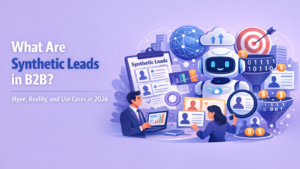

As B2B marketing becomes more data-driven, the term synthetic leads in B2B is gaining attention. In 2026, businesses are looking for faster ways to build pipeline, improve targeting, and train AI-powered tools without depending entirely on live customer data. That is where synthetic leads enter the conversation.
But are synthetic leads the future of B2B lead generation, or just another trend wrapped in AI buzzwords?
The answer lies somewhere in the middle.
What Are Synthetic Leads in B2B?
Synthetic leads are not real people actively looking to buy. Instead, the term usually refers to artificially generated lead records, modeled prospect profiles, or simulated datasets that are designed to reflect real-world business patterns.
In simple terms, synthetic leads are created using AI, machine learning, or statistical modeling to imitate what real lead data may look like. These records can include details such as company size, industry, job role, buying behavior patterns, and engagement signals.
In B2B, synthetic leads are often used for:
- Testing CRM workflows
- Training AI models
- Simulating lead scoring
- Improving segmentation strategies
- Running internal sales and marketing experiments
Why Are Synthetic Leads Getting Attention in 2026?
The growing interest in synthetic leads is closely tied to the rapid rise of AI in B2B marketing and sales. Teams want to automate more processes, personalize outreach at scale, and make smarter decisions using data.
At the same time, many companies face challenges with:
- Limited access to high-quality first-party data
- Privacy and compliance concerns
- Incomplete or outdated lead databases
- The need to test systems without using live customer information
Synthetic lead models appear attractive because they offer a way to create realistic business scenarios without exposing sensitive real-world data.
The Hype Around Synthetic Leads
Much of the hype comes from the belief that synthetic leads can help businesses generate pipeline faster and cheaper. Some marketers see them as a shortcut to smarter prospecting, stronger personalization, and better AI-driven campaigns.
This excitement is understandable. Companies want:
- More leads
- Better data quality
- Faster campaign testing
- Smarter automation
- Improved sales efficiency
In theory, synthetic leads can support all of these goals. They can help teams simulate large datasets, test internal systems, and train AI-based tools more effectively.
But this is where the hype needs to be balanced with reality.
The Reality: Synthetic Leads Are Not Real Demand
This is the most important point: synthetic leads do not create actual buyer intent.
A modeled record may look like an ideal customer profile, but it is still a prediction, not a real prospect showing purchase interest. Synthetic leads can support strategy, testing, and analytics, but they do not replace real first-party signals such as:
- Website visits
- Demo requests
- Form submissions
- Email engagement
- Product usage
- Sales conversations
In other words, synthetic leads can help businesses prepare for growth, but they cannot replace real market demand.
Use Cases of Synthetic Leads in B2B
When used correctly, synthetic leads can be very useful. Their value is strongest in internal operations, AI enablement, and controlled experimentation.
1. CRM and Workflow Testing
Businesses can use synthetic lead records to test automation, routing logic, dashboards, and lead scoring systems inside their CRM before applying changes to live data.
2. AI Model Training
Synthetic data can help train AI systems for lead qualification, forecasting, segmentation, and recommendation engines when real datasets are too limited or sensitive.
3. Ideal Customer Profile Modeling
Marketing teams can create lookalike lead patterns to explore new industries, buyer types, or account segments before investing heavily in campaigns.
4. Privacy-Safe Experimentation
Synthetic leads offer a safer environment for testing because they reduce the need to expose real customer or prospect information during internal analysis.
5. Sales and Marketing Alignment
Teams can use synthetic lead scenarios to train SDRs, test outreach strategies, and improve handoff processes between marketing and sales.
Risks and Limitations of Synthetic Leads
Although synthetic leads can be valuable, they also come with clear limitations.
Lack of Real Intent
The biggest weakness is that synthetic leads are simulated, not real buyers. They can support testing, but they cannot confirm purchase readiness.
Bias in the Data Model
If the original data used to create synthetic leads is biased or incomplete, the synthetic output may repeat the same problems.
Overconfidence in AI
Some businesses may assume that AI-generated lead profiles are accurate enough to drive major decisions without validation. That can lead to poor targeting and wasted budget.
Need for Human Oversight
Synthetic data still needs expert review. Human judgment is essential to validate assumptions, interpret patterns, and align results with business reality.
Synthetic Leads vs Real Leads
Understanding the difference is important for any business considering AI-powered lead generation.
| Synthetic Leads | Real Leads |
|---|---|
| Artificially generated or modeled | Generated from real buyer activity |
| Useful for testing and simulation | Useful for pipeline and revenue growth |
| Based on patterns and assumptions | Based on actual engagement and intent |
| Good for AI training and planning | Good for sales outreach and conversion |
The best strategy in 2026 is not choosing one over the other. It is combining synthetic modeling with real first-party data and human validation.
Are Synthetic Leads the Future of B2B Marketing?
Synthetic leads are not a replacement for demand generation. They are a supporting tool.
In 2026, the smartest B2B companies are using synthetic leads to strengthen internal systems, improve AI readiness, and test ideas faster. But real growth still depends on trusted data, genuine buyer signals, and a clear understanding of the customer journey.
So, are synthetic leads hype or reality?
They are both.
The hype comes from exaggerated expectations.
The reality is that synthetic leads can be valuable when used for the right purpose.
Final Thoughts
Synthetic leads in B2B are best understood as a testing and intelligence layer, not a direct source of revenue. They can help businesses improve targeting, train AI systems, and safely experiment with data-driven workflows. However, they should always be paired with real customer signals, strong governance, and human oversight.
For businesses in 2026, success will not come from generating more artificial leads. It will come from using AI responsibly to make real lead generation smarter, faster, and more efficient.