
In 2026, email growth isn’t limited by how many campaigns you can send—it’s limited by whether inbox providers trust you enough to deliver them.
That’s why deliverability has quietly become a top growth lever for B2B teams. When deliverability drops, everything downstream suffers: opens, replies, meetings booked, nurture performance, and even revenue forecasts. And it’s getting tougher because major inbox providers are enforcing stricter rules for high-volume senders.
Gmail has required bulk senders (5,000+ emails/day to Gmail) to meet specific standards since February 2024.
Microsoft has introduced requirements for high-volume senders to Outlook.com consumer domains (Outlook/Hotmail/Live), emphasizing SPF/DKIM validation and alignment.
So the new question isn’t “How do we send more?”
It’s: How do we earn inbox placement at scale?
The problem: “Delivered” doesn’t mean “seen”
Most email platforms report delivery as “accepted by the receiving server.” That’s not the same as inbox placement.
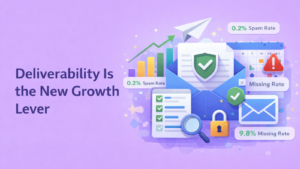
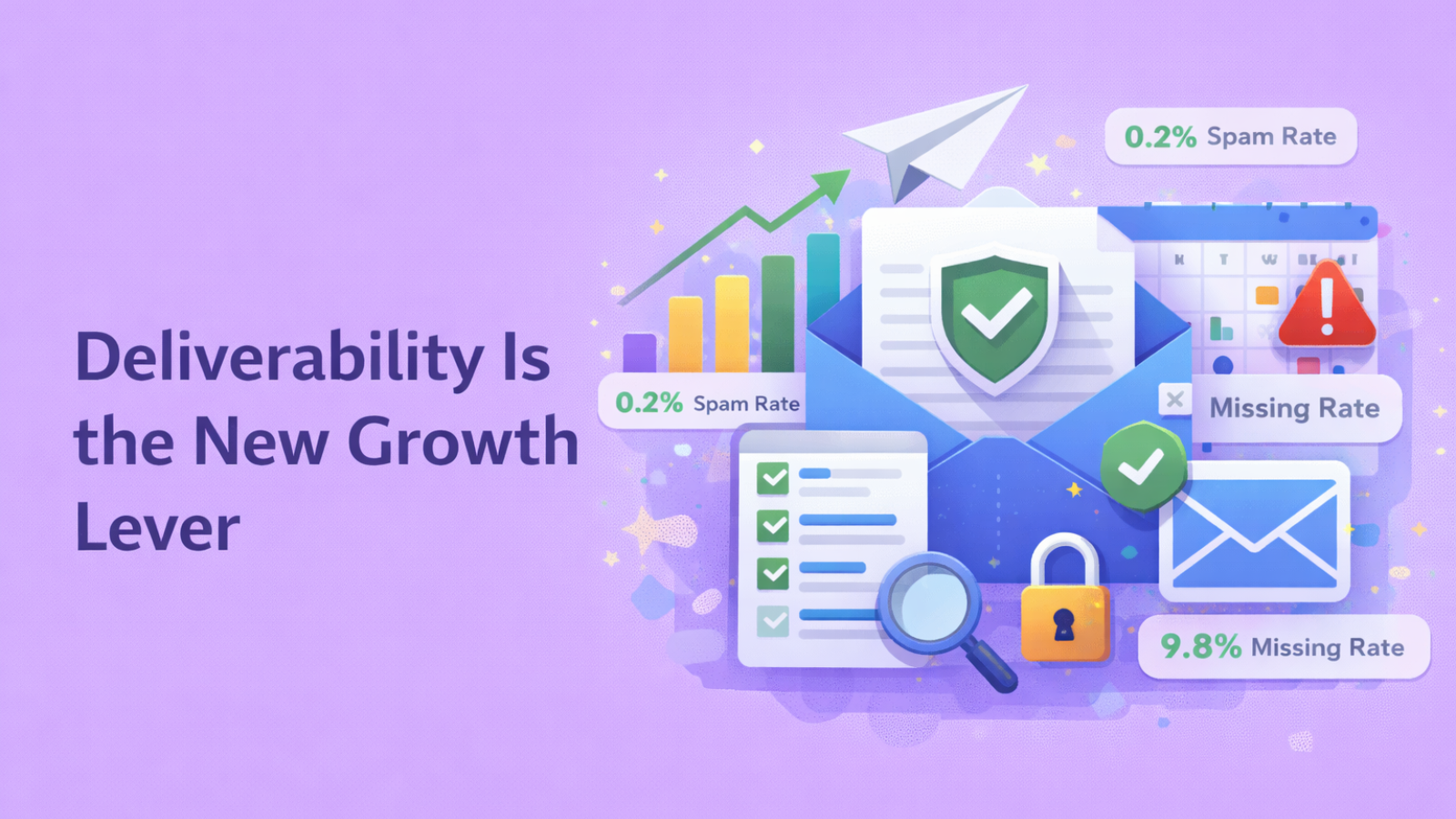
A recent global benchmark (Validity’s 2025 report) shows average inbox placement around 83.5%, with 6.7% landing in spam and 9.8% going missing (blocked/deferred/not placed).
That means roughly 1 in 6 legitimate emails may not land in the inbox—before your subject line or copy even gets a chance.
Why deliverability is now a growth lever
1) Inbox providers are turning requirements into enforcement
Gmail’s bulk-sender rules (authentication, easy unsubscribe, etc.) have been in place—but Google has also signaled stronger enforcement for non-compliant traffic starting November 2025, including temporary or permanent rejections.
In other words: deliverability isn’t just “best practice” anymore—it’s access.
2) Engagement is the new currency
Filters increasingly reward the behavior that looks “human” and helpful:
- consistent engagement (opens, clicks, replies)
- low complaints
- stable sending patterns
…and punish what looks noisy: - sudden volume spikes
- low engagement lists
- spam-like complaint patterns
3) B2B email is heavily exposed to Microsoft + Google filtering
B2B lists skew toward Google Workspace and Microsoft environments. Validity’s benchmarks show these providers can have meaningful “missing” and “spam” rates, which means you can’t rely on one blended average.
The 2026 deliverability benchmarks that matter
These are the few numbers worth watching monthly:
1) Inbox Placement Rate (IPR)
Your “true deliverability” metric. Use it as the headline KPI (overall + by provider). Benchmarks vary, but global averages hover in the low-to-mid 80s.
2) Spam Placement Rate
If spam placement trends upward across multiple sends, treat it as an early warning—even if opens look “okay” this week.
3) Missing Rate
Missing messages can signal throttling, blocking, auth misalignment, or list-quality problems. Globally it’s not small—around ~9.8% in Validity’s benchmark.
4) Spam Complaint Rate (hard thresholds)
Gmail guidance is explicit: aim to keep spam rate below 0.1%, and avoid reaching 0.3% or higher.
If you’re anywhere near 0.3%, your growth lever isn’t “more campaigns”—it’s reducing complaints immediately.
5) Authentication pass + alignment
For bulk/high-volume sending, strong authentication is table stakes:
- SPF + DKIM passing consistently
- DMARC set and monitored
Gmail requires authentication for bulk senders.
Microsoft’s high-volume requirements emphasize SPF/DKIM validation (with alignment rules).
What’s actually working in 2026 (without getting “salesy”)
Here are deliverability improvements that map to today’s reality:
1) Send less to the unengaged
The fastest way to improve deliverability is often to stop mailing people who never engage. Low engagement is a negative signal; consistent engagement is a positive one.
2) Stabilize volume and cadence
Sudden spikes trigger scrutiny. If you want growth, scale in steps and keep sending patterns predictable.
3) Make unsubscribing frictionless
Gmail’s bulk sender guidelines include “easy unsubscribe.”
Counterintuitive truth: making it easy to leave can protect you from spam complaints (the metric that actually hurts).
4) Segment by provider
Track Gmail vs Microsoft performance separately. A problem at one provider can hide inside your overall averages—and quietly cap growth.
The takeaway
In 2026, deliverability is the growth lever because it controls access to attention.
If you’re trying to grow with email, don’t start by writing more sequences. Start by protecting the fundamentals:
- inbox placement
- complaints
- missing rate
- authentication + alignment
- engagement-driven sending
Because the best email strategy in the world can’t grow your business if it never reaches the inbox.