
AI is not replacing video marketing in 2026. It is removing the bottlenecks that used to slow it down.
For years, video was one of the most effective content formats in marketing, but also one of the hardest to scale. It needed more time, more budget, more people, and more production coordination than blogs, emails, or static social content.
That is changing fast.
Wistia’s 2026 AI Video Trends report found that 49% of companies now have a dedicated AI budget, and most expect that budget to increase. At the same time, HubSpot’s 2026 marketing data shows that short-form video, live video, long-form video, and user-generated content are the top formats marketers plan to invest in, while website/blog/SEO remains the #1 ROI-generating channel. That combination matters: teams are not choosing between video and SEO anymore. They are building systems where AI helps them produce video faster and distribute it more intelligently.
Why AI is changing video marketing now
The old video workflow was linear.
A team would brainstorm a topic, write a script, book a shoot, record, edit, review, resize, caption, publish, then repurpose it manually for every channel. That process made high-volume video difficult, especially for lean marketing teams.
AI changes the economics of that workflow.
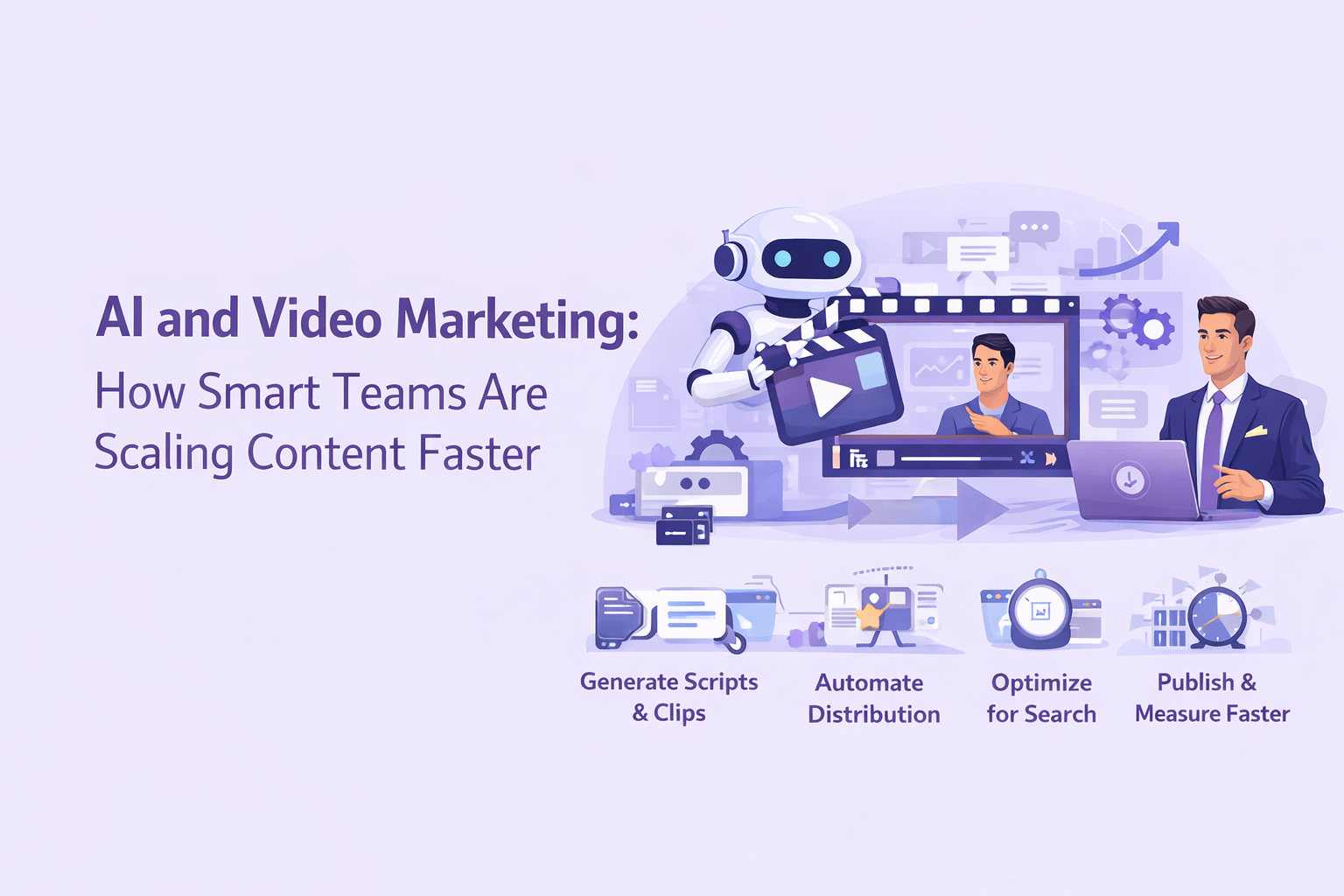
It helps teams:
- generate outlines and scripts faster,
- turn one long video into multiple short clips,
- create captions and summaries automatically,
- localize and version content faster,
- identify high-performing moments,
- and accelerate publishing without adding the same level of headcount.
The result is not just more content. It is faster content operations.
That is the real advantage.
Smart teams are not just making more videos. They are building reusable content engines.
The best marketers in 2026 are not using AI to flood channels with generic clips. They are using it to create a more efficient content system.
A single webinar, podcast, product demo, customer interview, or executive Q&A can now become:
- a long-form video,
- short social clips,
- a blog post,
- quote graphics,
- email content,
- landing page copy,
- and search-friendly supporting content.
This is where AI has the biggest impact: repurposing at scale.
Instead of creating every asset from scratch, teams are extracting more value from every original recording. That makes video more accessible for smaller teams and more productive for larger ones.
AI makes speed easier, but quality still decides performance
Speed alone is not a strategy.
As AI lowers the barrier to content production, the market gets noisier. That means smart teams need to use AI to improve execution, not to lower standards.
The videos that perform best still tend to do a few things well:
- solve a real audience problem,
- explain something clearly,
- hold attention quickly,
- reflect real expertise,
- and support a business goal.
In other words, AI can help you move faster, but it cannot replace strong positioning, a useful point of view, or a clear message.
The competitive edge comes from combining AI efficiency with human relevance.
Video marketing and SEO now work together
One of the biggest mistakes brands still make is treating video like a social-only format.
That no longer works.
Google’s Search Essentials apply to videos as well as web pages, and Google explicitly says its core requirements affect whether web-based content, including videos, is eligible to appear and perform well in Search. Google also recommends video sitemaps to help it find and understand video content, and says video structured data can make it easier for Google to find a video and influence how information like thumbnails, descriptions, and duration appears in search results.
That means AI-powered video teams should not just publish quickly. They should publish in a way that supports discoverability.
A stronger 2026 approach looks like this:
- create one high-value video asset,
- break it into channel-specific variations with AI,
- publish a search-optimized watch page,
- add transcripts, summaries, and structured data,
- and connect the video to supporting blog and landing page content.
This is where AI becomes especially powerful: it helps teams create the surrounding assets that make video easier to find, understand, and repurpose.
What smart marketing teams are doing differently
The highest-performing teams are not asking, “How can AI make all our videos for us?”
They are asking, “Where does AI remove friction from our workflow?”
That usually shows up in five areas:
1. Faster pre-production
AI speeds up ideation, content briefs, outlines, script drafts, and episode planning.
2. Faster post-production
Teams use AI to auto-caption, summarize, cut clips, generate titles, and suggest highlight moments.
3. Faster repurposing
One piece of video content turns into multiple assets across LinkedIn, YouTube, blog content, email, and sales enablement.
4. Faster optimization
AI helps identify what topics, hooks, thumbnails, and formats are driving stronger engagement.
5. Faster collaboration
Marketing teams can reduce handoff delays between strategy, production, distribution, and reporting.
That is why AI is becoming a force multiplier in video marketing. It does not just reduce workload. It improves throughput.
Where teams still go wrong
There is still a trap here.
When teams adopt AI without a content strategy, they often end up with:
- too much low-differentiation content,
- repetitive messaging,
- weak storytelling,
- and video assets that are fast to create but easy to ignore.
The solution is not to use less AI. The solution is to use AI with more clarity.
The best AI-powered video strategies are built around:
- clear audience intent,
- strong creative direction,
- expert-led insights,
- and content designed for both engagement and search visibility.
AI works best when it supports a system that already knows what it is trying to achieve.
How to scale video content faster in 2026
If you want to scale video marketing with AI, focus on this practical framework:
Start with a pillar asset
Use webinars, interviews, podcasts, demos, or customer stories as your source content.
Use AI to multiply formats
Turn one asset into clips, transcripts, articles, teaser posts, sales snippets, and recap emails.
Optimize for search and discovery
Create strong titles, descriptions, transcripts, watch pages, and video metadata. Google’s documentation is clear that structured data and sitemaps can help video discovery.
Match format to channel
Not every clip should look the same on LinkedIn, YouTube, your website, or email.
Measure business impact, not just views
Track watch time, qualified engagement, assisted conversions, pipeline influence, and reuse rate per asset.
Final thought
AI is making video marketing faster, but the real opportunity is bigger than speed.
It is helping smart teams turn video from a heavy production task into a scalable content engine.
The teams that win in 2026 will not be the ones that produce the most video just because AI makes it possible.
They will be the ones that use AI to produce better workflows, better reuse, better discoverability, and better business outcomes.
Because the future of video marketing is not just more content.
It is more leverage.