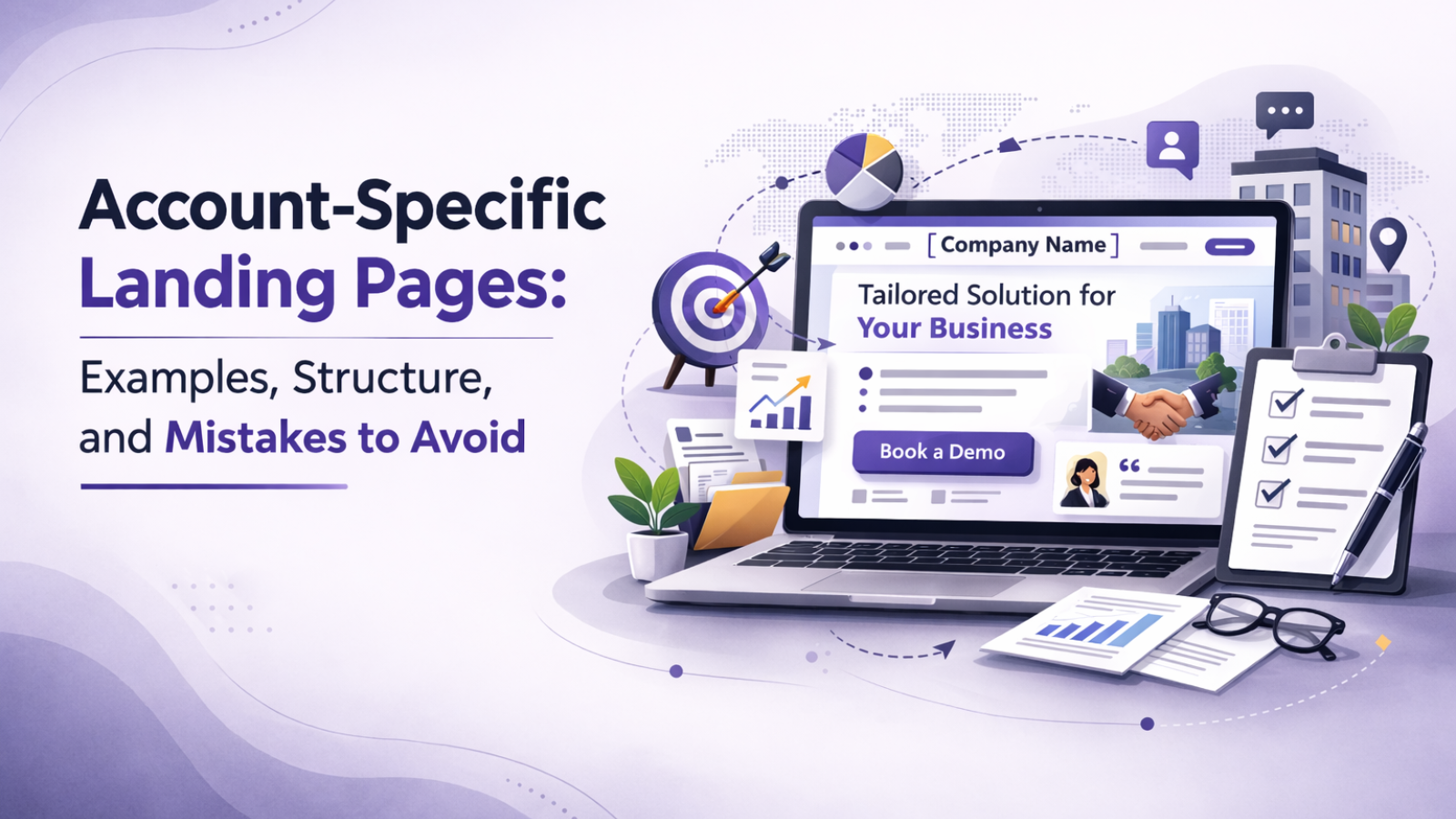

In B2B marketing, personalization is no longer optional. Buyers expect relevance. One of the most effective — yet underused — ways to deliver that relevance is through account-specific landing pages.
Instead of sending every prospect to the same generic page, account-specific landing pages tailor messaging, proof, and offers to a particular company or segment. When done right, they can significantly improve engagement, pipeline velocity, and conversion rates.
Let’s explore what they are, how to structure them, and common mistakes to avoid.
What Are Account-Specific Landing Pages?
An account-specific landing page (sometimes called personalized landing pages or ABM landing pages) is a web page customized for:
- A specific company
- A target account list
- A defined industry segment
- A strategic enterprise prospect
These pages align directly with the account’s goals, challenges, and use cases — rather than speaking to a broad audience.
For example:
- A SaaS company targeting a fintech enterprise may reference compliance, risk management, and relevant case studies.
- A marketing platform targeting an eCommerce brand may highlight conversion optimization and performance analytics.
The key difference? Relevance over volume.
Why Account-Specific Landing Pages Work
B2B buying cycles are long and involve multiple stakeholders. Personalized landing pages:
- Increase engagement by addressing real business priorities
- Improve conversion rates from outbound and ABM campaigns
- Strengthen sales conversations with tailored proof points
- Reduce friction by eliminating irrelevant messaging
When prospects feel understood, they move faster.
Structure of a High-Converting Account-Specific Landing Page
A strong account-based marketing (ABM) landing page typically includes:
1. Personalized Headline
Clearly reference the company or industry.
Example:
“How [Company Name] Can Reduce Operational Risk by 30%”
This immediately signals relevance.
2. Industry or Company Context
Demonstrate understanding of:
- Their market
- Competitive pressures
- Regulatory environment
- Business objectives
Avoid generic pain points.
3. Tailored Value Proposition
Explain how your solution directly impacts their KPIs:
- Revenue growth
- Cost reduction
- Efficiency gains
- Risk mitigation
Specific outcomes outperform vague benefits.
4. Relevant Social Proof
Include:
- Case studies from similar companies
- Testimonials from the same industry
- Metrics that mirror their goals
Proof builds trust.
5. Clear Call-to-Action (CTA)
Make the next step easy and logical:
- “Book a Strategy Session”
- “See a Custom Demo”
- “Download the Industry Playbook”
Avoid overly aggressive sales language.
Examples of Account-Specific Landing Pages
- Enterprise SaaS targeting a Fortune 500 retailer
Custom landing page referencing supply chain optimization, with a retail-focused case study. - Cybersecurity firm targeting healthcare organizations
Page emphasizing HIPAA compliance and patient data protection. - Marketing automation platform targeting fintech startups
Messaging focused on regulatory marketing workflows and scalable growth.
In each case, the page reflects the account’s reality — not a one-size-fits-all pitch.
Common Mistakes to Avoid
1. Superficial Personalization
Adding only a company logo or name isn’t enough. Real personalization addresses strategy, challenges, and priorities.
2. Over-Personalization Without Accuracy
Incorrect assumptions damage credibility. Research matters.
3. Too Much Custom Content
Don’t rebuild the entire website for one account. Use modular sections that can be adapted efficiently.
4. Forgetting SEO Basics
Even account-specific landing pages should follow SEO best practices:
- Clear keyword targeting (e.g., account-based marketing landing page, personalized B2B landing pages)
- Optimized meta descriptions
- Fast loading speeds
- Mobile responsiveness
Personalization and search optimization can coexist.
Final Thoughts
Account-specific landing pages sit at the intersection of ABM strategy, personalization, and conversion optimization. They’re not about being flashy — they’re about being relevant.
In a competitive B2B landscape, relevance is often the difference between being considered and being ignored.
If you’re investing in targeted outreach or account-based marketing, tailored landing pages aren’t just a nice addition — they’re a strategic advantage.